Imagine two screens. Both show the same thing: 1 ETH. In the first case, the crypto is held in an account on a large centralized platform. You log in with a username and password, you can recover access through support, and the company itself controls the infrastructure that allows the assets to be transferred.
In the second case, the same 1 ETH appears in a non-custodial wallet. There may be no login at all, customer support cannot restore access to your funds, and every transaction depends on keys controlled by the user.
From an ownership perspective, the difference is enormous. So why is it not always obvious in practice?
The Furniture Is Yours. The House Isn’t.
In finance, custody means holding assets on behalf of someone else. Banks do it all the time. Brokers do too. In crypto, that role can be played by centralized exchanges and other services that control the private keys to the addresses where users’ funds are actually held. For the customer, this is convenient: there is no need to deal with private keys, seed phrases, or backups. Forgot your password? You can try to recover the account. Changed your phone? Just log in again. Something went wrong? Contact support. But in this model, there is an intermediary that technically controls the keys.
When an interface shows “1 ETH,” it means the service keeps a record of your entitlement to that asset, while withdrawals happen through the platform’s infrastructure and according to its rules. In a non-custodial model, the situation is reversed — there is no intermediary holding the keys on the user’s behalf.
Not Your Keys, Not Your Coins
Imagine you want to send some crypto. With a custodial service, the request first passes through the company’s infrastructure. The platform may check your account, request additional verification, temporarily restrict withdrawals, or refuse to process the transaction altogether — because of internal policies, a technical issue, or regulatory requirements.
A non-custodial wallet works differently. If the user has the necessary private keys and the network is functioning, the user signs the transaction. The wallet does not “approve” the transfer — it simply helps create and sign it before broadcasting it to the blockchain.
Which of these two models is better is up to you. The important thing is to understand that if someone else controls the keys, the final technical control over moving the asset does not belong entirely to you either…
“Forgot Your Password?”
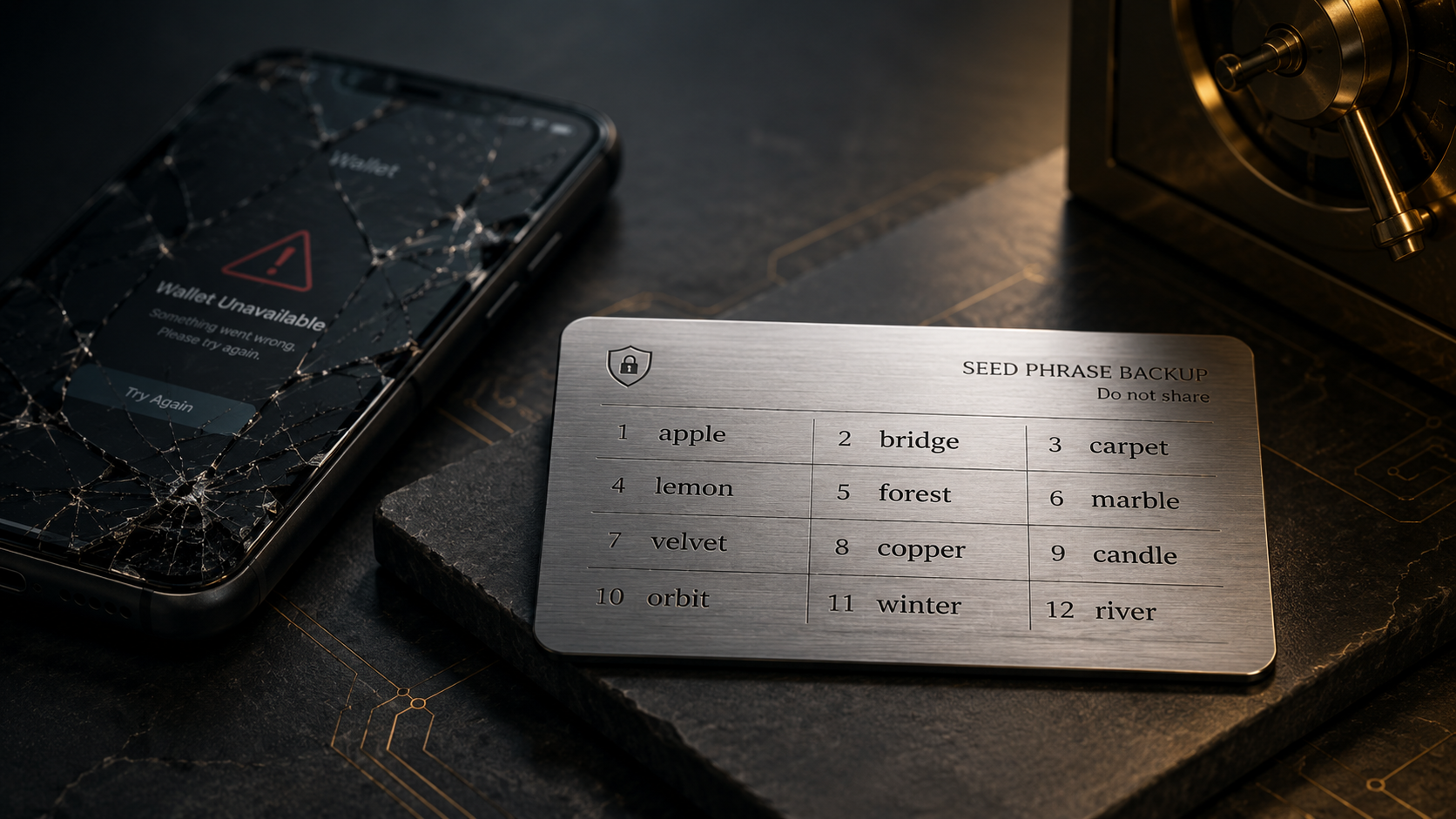
As we explained in our article about seed phrases, the coins themselves are not sitting inside an app on your phone. A wallet is simply an interface for interacting with the blockchain and a tool for managing keys. It does not really matter what happens to your phone or the app installed on it, as long as you still have the information needed to regain access to those keys.
In most familiar seed-based wallets, that recovery point is the seed phrase. And that is why moving from a custodial to a non-custodial model changes not only who controls the asset, but also who is responsible for recovering access.
With a regular online service, there is an administrator who knows that your account belongs to you. They can send an email, request documents, verify your phone number, or use another recovery method. In a true self-custody model, the wallet developer does not have a secret master key waiting in reserve in case the user loses everything. That is intentional: control over the keys is supposed to remain exclusively with the owner.
Does Non-Custodial Mean Safer by Default?
This is one of the most dangerous misconceptions around self-custody. Non-custodial primarily means a different model of control, not a higher level of security by default.
When assets are held on a centralized platform, the user takes on intermediary risk: the service could be hacked, become insolvent, restrict withdrawals, limit an account, or run into other problems on the company’s side. With self-custody, some of those risks disappear — but others take their place.
The user can:
- lose the seed phrase;
- give it to a phishing site;
- sign a malicious transaction;
- install a fake wallet app;
- send funds to the wrong address;
- lose the keys with no way to recover them.
Ultimately, the choice comes down to who you trust more: a particular company or yourself. And there is no universally right or wrong answer.
Best of Both Worlds
The crypto industry likes to present the absence of intermediaries as an unconditional advantage. But sometimes an intermediary is useful precisely because it is an intermediary. A platform may stop a suspicious withdrawal, help restore access, simplify buying crypto with traditional money, or shield the user from some of the technical complexity of blockchain transactions.
For someone who has just bought their first $100 worth of crypto and is already worried about forgetting their Gmail password, taking full responsibility for cryptographic keys may feel less like freedom and more like an additional source of risk. An experienced user, on the other hand, may have no need for that safety net at all — in which case self-custody may be the better fit.
Custodial and non-custodial solutions do not necessarily have to compete for the role of a user’s one and only wallet. The same person might use a centralized exchange to buy and sell assets while keeping the long-term portion of the portfolio under self-custody. Or they might keep a smaller amount in a hot non-custodial wallet for DeFi while storing another portion in a more isolated setup.
Using self-custody does not mean turning your entire financial life into a single seed phrase. If anything, the larger the amount involved, the more important it becomes to think not only about which app to use, but about how the risk itself is distributed.
So What Does a Non-Custodial Wallet Look Like in Practice?
Different products are designed for different networks, devices, and levels of user experience.
| Wallet | Type | Best suited for |
| AIISAAC.finance | Non-custodial Web3 wallet with an ecosystem model | Crypto storage, staking, passive income opportunities, Web3 activity, partner program |
| MetaMask | Browser and mobile Web3 wallet | Ethereum, EVM networks, DeFi, NFTs, decentralized applications |
| Trust Wallet | Mobile multi-chain wallet | Storing multiple cryptocurrencies, swaps, NFTs, DeFi, multi-network usage |
| Ledger | Hardware non-custodial wallet | Long-term offline storage and stronger protection for larger balances |
| Trezor | Hardware non-custodial wallet | Cold storage and protection of private keys outside phones and computers |
| Phantom | Non-custodial wallet for Solana and other networks | Solana ecosystem, NFTs, DeFi, fast transactions |
| Rabby Wallet | Web3 wallet for EVM networks | Active DeFi usage, transaction previews, multi-network management |
| Exodus | Desktop and mobile non-custodial wallet | Simple interface, multi-asset storage, beginner-friendly use |
| SafePal | Mobile and hardware wallet ecosystem | Storage, swaps, DeFi access, hardware-level protection |
| Coinbase Wallet | Non-custodial wallet by Coinbase | Web3, DeFi, NFTs, self-custody separate from the Coinbase exchange account |