On August 17, Taiwan’s President Lai Ching-te announced a universal NT$10,000 (~US$314) cash handout to every resident in 2027, explicitly calling it an “AI dividend” funded by record tax revenue from the semiconductor boom. It is the first national payout anywhere to frame AI-driven growth as a redistributable windfall. Economists I’ve spoken with see a short-term consumer boost — and a longer-term fiscal trap waiting to snap shut.
What actually happened
President Lai’s office dropped a short press release on Monday afternoon that contained five numbers worth memorizing:
- NT$10,000 (~US$314) to every resident in 2027
- NT$235.7 billion (US$7.4B) total budget line
- NT$3.9266 trillion projected 2027 central government revenue
- 11.05% revised-up 2026 GDP growth forecast (from 9.64%)
- 14.15% actual first-half 2026 growth — the strongest six-month stretch in 39 years
The money comes from excess tax receipts driven by AI, high-performance computing, and cloud demand — essentially, the TSMC supply chain paying more corporate tax than expected. Lai framed it plainly: “The AI dividend can be shared by all.” Details on eligibility, distribution method, and timing remain unreleased as of publication.
One thing to notice: this is the second NT$10,000 universal handout. The first shipped in 2025 from a special budget aimed at offsetting U.S. tariffs and inflation. So Taiwan has now built a precedent — and that precedent matters more than the headline number.
The numbers behind the payout
| Metric | Value | Context |
|---|---|---|
| Per-capita payout | NT$10,000 (US$314) | ~1.8% of median household monthly income |
| Total program cost | NT$235.7B (US$7.4B) | ~6% of projected 2027 central revenue |
| % of GDP | ~1.0% | Comparable to 2021 US stimulus checks (one round) |
| Defense spending 2027 | NT$1.1225T | First time above NT$1T; >3% of GDP |
| 2026 GDP growth (revised) | 11.05% | Highest since 1987 export-led boom |
The defense number isn’t incidental. Lai bundled the handout with a record defense budget — the signal is deliberate: “We’re rich enough to share, strong enough to defend, and not borrowing to do either.”
Short-term outlook for Taiwan (next 6-12 months)
Consumer boost, yes, but smaller than politicians hope. Historical evidence from Japan’s ¥10,000–30,000 handouts in 2023-2024 and the 2025 Taiwan round itself shows a marginal propensity to consume out of universal transfers of roughly 0.4–0.6. Most of the money goes to paying down debt or into savings. Expect a modest lift in retail, restaurants, and domestic tourism in Q1-Q2 2027 — maybe 0.3-0.5 percentage points added to private consumption — not a sugar rush.
Inflation pressure is real. Taiwan’s economy is already running hot. 14.15% H1 growth with an output gap essentially closed means new demand meets constrained supply. The Central Bank of China (CBC), holding its policy rate at 2.00%, may need to lean hawkish into late 2026 to pre-empt a pass-through. Watch the August and September CPI prints — anything sustained above 2.8% YoY will force the CBC’s hand.
The political timing is not subtle. Local elections are scheduled for November 28, 2026 — three months before the first NT$10,000 checks arrive. The opposition Kuomintang already called the move a “double standard” within 24 hours, arguing the Cabinet is using tomorrow’s budget to buy today’s votes. Whether that lands depends on whether households feel the 2025 handout helped. Early polling suggests they remember it fondly.
NT$ stays firm. Because this is tax-funded rather than debt-funded, the currency implication is neutral-to-positive. Foreign capital doesn’t flee fiscal expansions that don’t borrow. The USD/TWD pair should hold its recent range.
Long-term risks for Taiwan (2027-2030)
This is where the story gets less cheerful. I see four structural problems that the handout does not solve — and arguably makes worse.
1. The semiconductor cycle is a cycle. TSMC’s revenue is 70%+ exposed to AI/HPC right now. Every semiconductor super-cycle in the last 40 years has been followed by a sharp correction. When — not if — AI capex cools, Taiwan’s tax receipts will crater. Committing NT$235.7B as an annual line item assumes the windfall is permanent. It isn’t.
2. Dutch disease, domestic edition. Lai himself acknowledged that “the benefits of economic growth have not been felt equally” — tech workers in Hsinchu are thriving, services and SMEs in Kaohsiung and Tainan are not. A universal handout is a blunt instrument that gives NT$10,000 to a TSMC engineer earning NT$3M and the same to a night-market vendor. It treats the symptom (unequal gains) while leaving the disease (a two-speed economy anchored to one company) untouched.
3. The precedent trap. Once you call something an “AI dividend,” voters will expect it every year. Cut it in 2029 because chip revenue dipped, and you’re the government that took away people’s AI money. Every future administration inherits this liability. Japan discovered this after its repeated stimulus rounds — each one raised the baseline expectation for the next.
4. Demographics make universal payouts inefficient. Taiwan’s median age is 43 and climbing. Roughly 20% of the population is over 65. A flat handout sends nearly a fifth of the budget to retirees who already have savings and pensions, rather than to the working-age households whose spending has a higher multiplier. Targeted transfers would have delivered more consumption per dollar.
Global spillovers: who else might follow
Taiwan is not a large economy in dollar terms, but it is a signal economy. Three channels matter globally:
The “AI rent-sharing” club. South Korea (Samsung, SK Hynix), the Netherlands (ASML), Singapore, and Ireland all run massive current account surpluses driven by a handful of AI-adjacent firms. Finance ministries in Seoul, The Hague, and Dublin are now watching Taiwan’s political payoff from the announcement. I’d bet we see a “digital prosperity dividend” proposal in at least one of those countries within 18 months. South Korea’s presidential election in 2027 is a likely catalyst.
Pressure on the US. The American AI boom is generating record corporate tax revenue from NVDA, MSFT, GOOG, META — and almost none of it is being redistributed to households. Taiwan’s framing (“the AI dividend can be shared by all”) is a rhetorical grenade lobbed into the 2028 US presidential race. Expect progressives to pick it up.
The Beijing angle. China will use this two ways: as propaganda (“the mainland could do more if not for US sanctions on chips”) and as a vulnerability signal (“Taiwan is burning reserves on handouts”). Neither reading is quite right, but both will shape cross-strait rhetoric through 2027.
Why this isn’t really UBI (and why that matters)
Some outlets are calling this “Taiwan’s UBI.” It isn’t. UBI is recurring, unconditional, and funded from general taxation. This is a one-time (so far) windfall-sharing from a specific sector’s tax overperformance. The distinction is not pedantic — it’s the whole point.
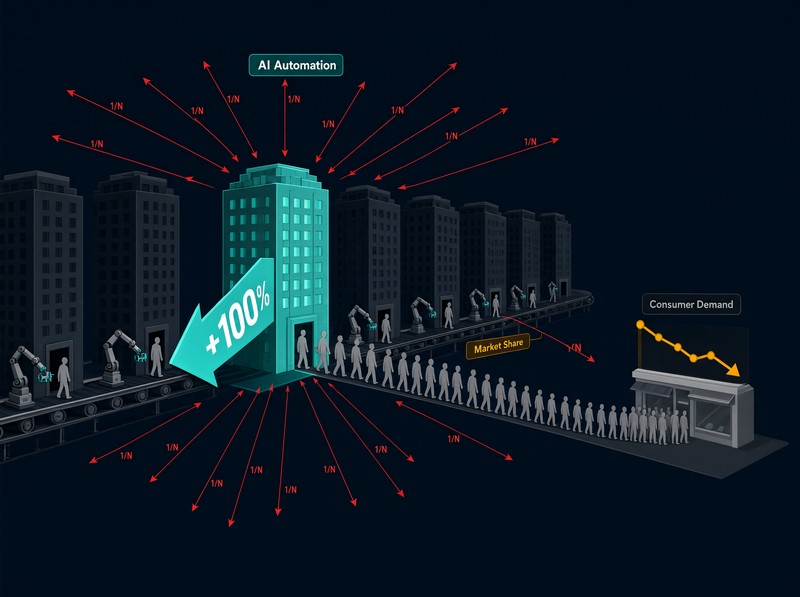
In our recent deep-dive on the AI Layoff Trap, we walked through the Falk and Tsuyuskas paper showing that universal transfers don’t solve the externality problem of automation — only Pigouvian taxes on AI-driven layoffs do. Taiwan’s handout is the real-world version of that theoretical result: it makes people feel richer today but does nothing to price the negative externality of job displacement. The automation arms race keeps running.
Which is fine, if the goal is political and short-term. It’s a problem if the goal is structural.
Three scenarios for 2027-2028
| Scenario | Probability | What happens |
|---|---|---|
| Base case | 55% | AI demand moderates but stays strong; Taiwan grows 5-7% in 2027; handout proceeds on schedule; mild consumption bump; no major inflation shock. CBC holds rates. |
| Bull case | 20% | AI super-cycle extends into 2028; Taiwan becomes the template for “AI rent sharing”; Korea and Netherlands announce similar programs; NT$ strengthens; TSMC breaks US$1T market cap. |
| Bear case | 25% | AI capex pauses, US-China chip tensions escalate, or a cross-strait incident shocks markets; tax receipts miss by 15%+; Lai faces pressure to cancel or cut the handout; KMT uses it as a 2028 campaign weapon. |
What to watch
- September 2026: Detailed eligibility rules and distribution mechanism from the Cabinet
- November 28, 2026: Local elections — first real political test of the announcement
- Q1 2027: CBC rate decision — will it pre-empt the fiscal stimulus?
- Q2 2027: Actual disbursement and high-frequency consumption data
- Throughout: South Korea and Netherlands for copycat proposals
For more on the macro backdrop this plays out against, see our H2 2026 economic calendar, which tracks every FOMC, BOJ, and ECB decision through year-end.
FAQ
How much is Taiwan’s AI dividend in US dollars?
The payout is NT$10,000 per resident, which converts to roughly US$314 at the August 2026 exchange rate. The total program costs NT$235.7 billion, or about US$7.4 billion — roughly 1% of Taiwan’s GDP.
When will Taiwan residents receive the AI dividend?
The payout is scheduled for 2027 as part of the 2027 central government budget. As of August 20, 2026, the Presidential Office has not released the exact distribution date, method, or final eligibility criteria.
Is Taiwan’s AI dividend the same as universal basic income (UBI)?
No. UBI is recurring, unconditional, and funded from general taxation. Taiwan’s NT$10,000 payment is a one-time windfall sharing from excess AI-related tax revenue. Economists distinguish between the two because only recurring transfers change long-term behavior.
Will other countries copy Taiwan’s AI dividend?
Likely yes. South Korea, the Netherlands, Singapore, and Ireland all have concentrated AI/semiconductor sectors generating windfall tax revenue. South Korea’s 2027 presidential race is the most probable venue for a similar proposal.