⚠️ Risk disclaimer: This note is information, not individual investment advice. Markets can move against any scenario below. Never risk capital you cannot afford to lose.
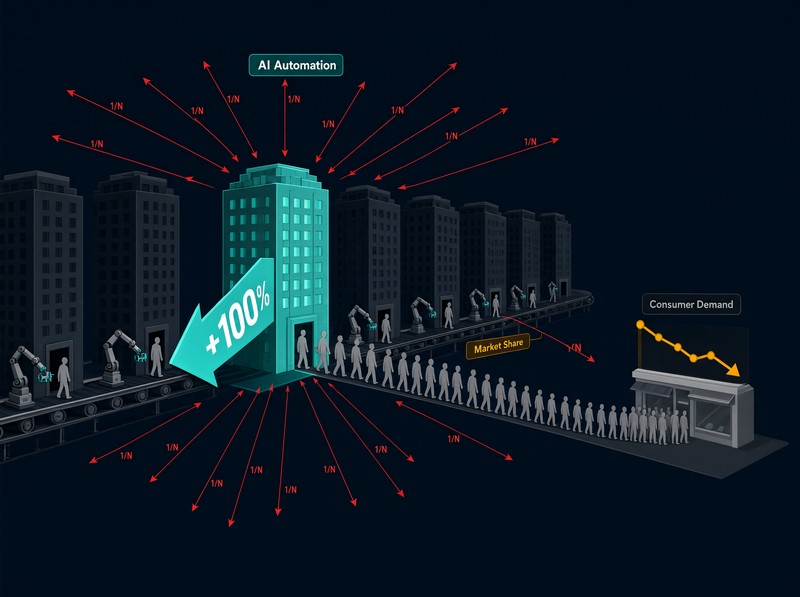
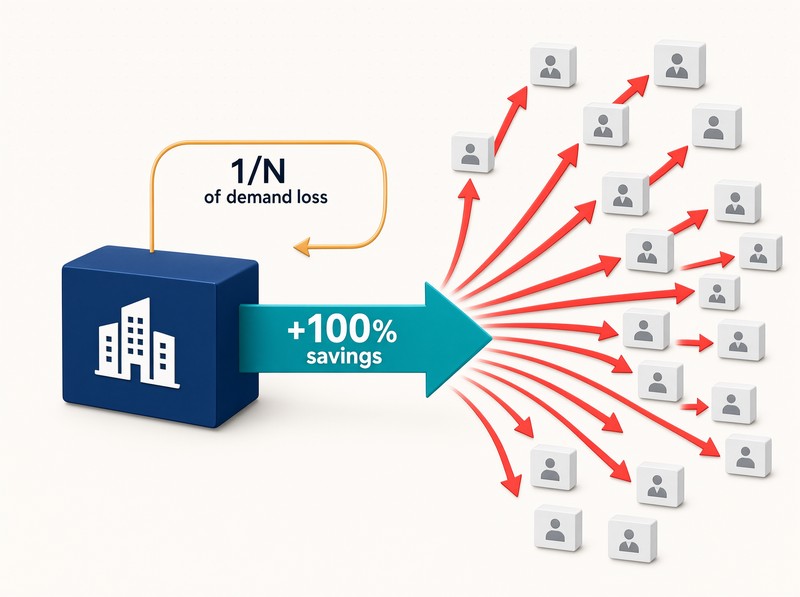
The AI Layoff Trap is a demand externality: each firm that replaces workers with AI keeps 100% of the payroll saving but bears only 1/N of the resulting hole in consumer demand, spreading the rest across rivals. Firm by firm that is rational. In aggregate it is a recession. Falk and Tsoukalas (arXiv:2603.20617) show only a Pigouvian automation tax closes the gap.
I first saw the paper forwarded by a rates strategist in June, with a one-line note: “this is why the rally feels wrong.” The June payrolls print had already shown hiring stalling. US corporate bankruptcies were running 15% higher year on year, per Coface’s Risk Review 2026. And yet the tape kept grinding higher on AI capex headlines, with semiconductors up over 100% in the first half. The paper is the cleanest explanation I have read for that dissonance. So let me translate it into trader.
What the paper actually proves
In a competitive task-based model, firms automate beyond the collectively optimal level because they internalize the full cost saving and only a sliver of the demand damage. The excess grows with competition and with AI capability, and it survives wage flexibility, free entry, UBI, worker equity, upskilling and Coasean bargaining. Both workers and firm owners end up poorer.
The numbers that matter, in plain English:
- A firm that automates captures 100% of the payroll saving.
- It bears 1/N of the demand destruction it creates. The other (N-1)/N lands on rivals’ P&Ls.
- Result: an automation arms race that displaces workers well past what the industry as a whole would choose.
- More competition and “better” AI make the overshoot worse, not better.
- The aggregate loss hits workers and firm owners. Shareholders do not escape by being shareholders.
Read that last bullet twice. It flips the usual “shareholders win, workers lose” framing on its head. In this model the people who own the firms also lose, because the owners’ gains are eaten back through a shrinking customer base. That is why this paper is landing on macro desks, not just in policy seminars.
The napkin version: 1/N is a license to eat your own customers
Take a market of 200 firms. One automates, cuts $20M of payroll, and the displaced workers spend roughly $14M less. The cutter feels $14M divided by 200, about $70K. The private math is a no-brainer; the social math is a slow-motion car crash, because every rival runs the same no-brainer a quarter later.
Round one, nobody notices. Round two, ten rivals copy the playbook and the demand hole is $140M, but our original cutter still feels less than a million of it. Round six, the auto dealer, the mortgage book and the mall landlord in that town are all bleeding, and now the cutter’s own revenue is down 8% because the whole region is poorer.
At no single step was stopping the rational choice. That is the entire trap. Nobody decides to wreck demand. It gets wrecked in the fourth decimal of two hundred separate P&L statements.
Why macro desks care: a disinflationary shock with a lag
Mass AI layoffs are disinflationary. Wages are the stickiest input in CPI, and a white-collar layoff wave caps both wage growth and consumption, turning the Fed’s soft landing into a demand shortfall. The bond market gets it first: long-duration Treasuries bid up, terminal rate expectations drift below the 3.75% the Fed holds today.
Here is the wrinkle. The Fed is currently trapped between sticky services inflation and a labor market that is quietly cracking. A layoff arms race resolves that tension in one direction only. Every wave of white-collar cuts makes the September 16 and December 9 dot plots dovisher, and the market will start pricing that before the data shows it. I have been watching the 10-year outperform equities on weak hiring prints all summer. The H2 2026 financial calendar we published last week lists the exact dates where this fight gets settled.
Equity investors should ask one uncomfortable question: who buys the product? Cheaper production is wonderful until the marginal customer is a displaced project manager with a severance package and no income.
The market map: who eats the loss first
First-order winners are the automation supply chain and any company that cuts domestic costs while selling abroad, because the demand externality lands on the domestic economy, not on their export book. First-order losers are whatever depends on the displaced middle class spending: consumer discretionary, auto credit, malls, and the ABS shelves built on their paychecks.
A few nuances I keep circling on my own screen:
- Exporters partially escape the trap. A firm that automates at home and sells overseas externalizes the demand hit to somebody else’s consumers. Beggar-thy-neighbor, corporate edition. This is one more reason the global economy keeps fragmenting into blocs.
- Concentration risk is the equity story. About 87% of the S&P 500’s first-half gain came from semis and computer hardware (Barclays, via Finam). If the layoff trap starts showing up in consumer data, the narrow leadership has nowhere to hide. We covered the flip side of this trade in The AI Cannibal: Why Legacy Tech Equities Are Bleeding Out.
- Consumer credit is the canary. Bankruptcies already up 15%, and young savers were migrating yield out of banks long before this started (why banks are losing young investors). A layoff wave accelerates that squeeze straight into delinquency data.
The only fix nobody wants to say out loud
The authors’ fix is a Pigouvian automation tax sized to the demand damage a firm dumps on rivals. It does not ban AI: if a deployment genuinely saves enough, it still pays for itself after the tax. What it kills is the pure arbitrage of firing people because the bill lands on everybody else’s customers.
Politically, this is gasoline. The November 3 midterms are eleven weeks away, and “automation tax” is exactly the kind of slogan that travels well in a campaign ad. Watch for it. My base case is that nothing gets legislated in 2026, but the debate itself will cap tech multiples every time a layoff headline trends. The paper’s quieter finding matters more for investors: universal basic income, worker equity and upskilling all redistribute the damage after it happens. Only the tax prices the damage before it happens. That distinction will get mangled in the political noise, so keep it in your pocket for when the noise peaks.
Three ways the second half plays out
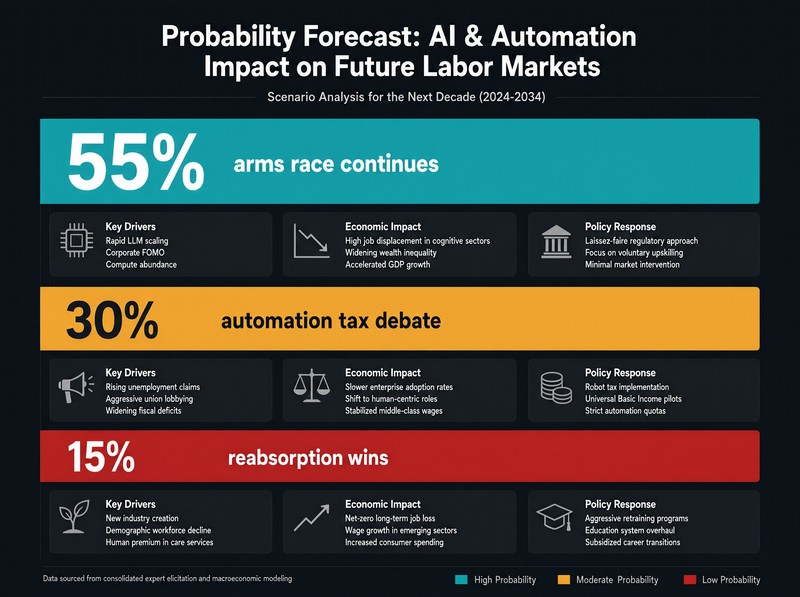
Base case: the arms race continues, no legislation, consumer spending softens into 2027 and duration rallies. Alt case: midterm politics force an automation tax debate and tech multiples compress. Tail case: reabsorption beats the model and the trap never closes.
| Scenario | Probability | What the tape does |
| Arms race continues, no tax in 2026 | 55% | S&P chops with narrow leadership; 10-year yields drift down; consumer credit stress builds quietly |
| Layoff headlines dominate midterms, automation tax enters serious debate | 30% | Tech multiple compression, VIX spikes, defensives and duration outperform |
| Labor reabsorption runs faster than the model | 15% | Trap thesis falsified; cyclicals, small caps and consumer discretionary rally hard |
What I changed in my own book
I can’t trade a paper, but I can trade its second derivatives. This month I trimmed consumer discretionary exposure, added a small long-duration position, tightened stops on the semi book, and let the news flow run through the algo instead of my thumbs.
That last one matters more than people admit. In a regime where every layoff headline reprices rates within minutes, discretionary thumbs lose to machines that read the calendar while you sleep. It is the same reason we built our GPTBot track record the way we did, warts and all (how we run it, year one).
The last time an industry externalized its way into a demand hole, we called it 2008 and blamed the banks. This time the externality sits on the payroll line, and the rational move for every CEO is to keep cutting until the math stops working for everyone. Keep your stops tight.
Frequently Asked Questions
What is the AI layoff trap?
The AI layoff trap is a demand externality in which each firm keeps the full cost saving from replacing workers with AI but bears only 1/N of the resulting fall in consumer demand. Since rivals absorb the rest, every firm rationally over-automates, and the industry collectively shrinks its own customer base.
Can an automation tax stop AI layoffs?
A Pigouvian automation tax, sized to the demand damage a firm imposes on rivals, removes the incentive to lay off workers purely to externalize costs. It does not stop genuinely productive AI: deployments that save enough still pay for themselves after the tax.
Are mass AI layoffs inflationary or deflationary?
Deflationary. Layoffs cap wage growth, the stickiest component of CPI, and erode consumer demand. A sustained white-collar layoff wave pushes the economy toward a demand shortfall, which supports long-duration bonds and lowers the Fed’s terminal rate.
Which assets lose first from mass AI layoffs?
Anything dependent on middle-class spending: consumer discretionary, auto loans and their ABS packaging, retail real estate, and private credit exposed to consumer balance sheets. Exporters and the automation supply chain are comparatively insulated in the near term.