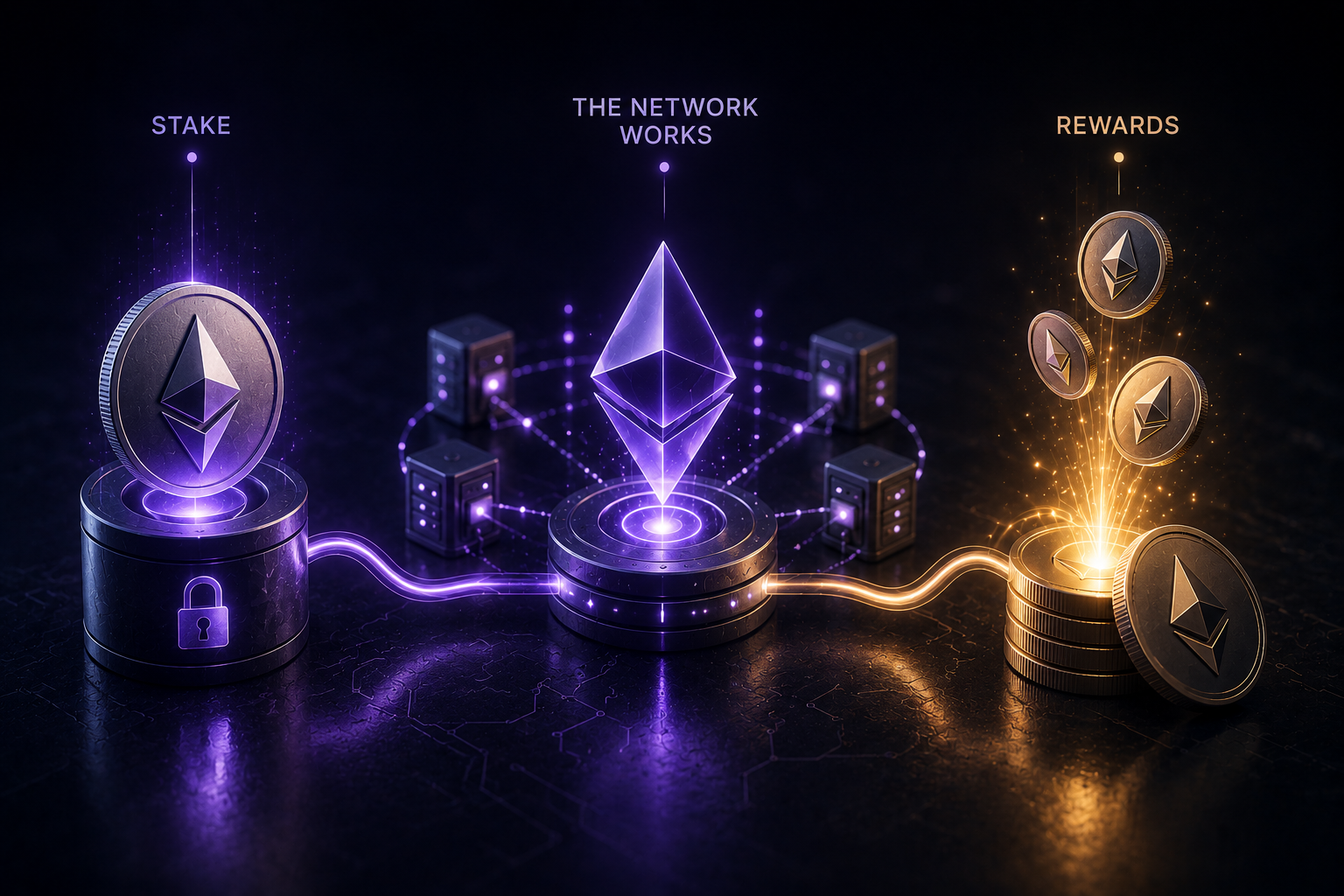
If you’re holding cryptocurrencies, you’ve probably heard about staking. And if you’re not staking your PoS assets in 2026, you’re essentially leaving free money on the table. But with so many networks offering wildly different yields — from Ethereum’s modest 2.7% to Cosmos pushing past 20% — the real question isn’t whether to stake, but where.
This guide breaks down the staking rewards landscape in 2026. We’ll compare APYs across the major Proof-of-Stake networks, explain what those numbers actually mean for your wallet, and — most importantly — walk through the risks that can turn a seemingly great yield into a loss.
Let’s get into it.
What Is APY and Why Does It Change?
Before we compare numbers, it’s worth understanding what you’re actually looking at.
APY (Annual Percentage Yield) reflects the total return you can expect from staking over a year, including compounding effects. This is different from APR (Annual Percentage Rate) , which doesn’t account for compounding. When a platform advertises “6% APY,” your rewards are being reinvested automatically — so your effective return compounds over time.
But here’s the catch: staking yields aren’t fixed. They fluctuate based on several factors:
- Total amount staked on the network — more stakers = lower rewards per person, since the reward pool is split among more participants.
- Network activity — busier networks generate more transaction fees, which boost validator revenue.
- Token inflation — many networks mint new tokens as staking rewards. If inflation outpaces your yield, your “real” return may be much lower than it appears.
Understanding these dynamics is the first step to making a smart staking decision.
Staking Rewards Comparison Table (July 2026)
Here’s how the major PoS networks stack up against each other right now:
| Cryptocurrency | APY Range | Real Yield (Approx.) | Unbonding Period | Validator Commission (Avg.) | Minimum to Stake |
| Ethereum (ETH) | 2.7% – 4% | ~2.8% | ~1–2 days (liquid) / 53+ days (solo) | 10–25% (exchange) / 5–10% (solo) | 32 ETH (solo) / none (liquid) |
| Solana (SOL) | 5.7% – 8% | ~5.7% | ~2–3 days | 5–10% | None (delegation) |
| Cosmos (ATOM) | 14% – 21% | 2–8% | 21 days | 5–10% | ~0.5 ATOM |
| Polkadot (DOT) | 7.4% – 15% | ~7–12% | ~28 days | Varies | ~0.5 DOT |
| Cardano (ADA) | 2.8% – 4.5% | ~2–3% | None (liquid) | ~0–5% | None |
Note: All figures are approximate and based on network conditions as of July 2026. Yields change constantly — always check current rates before staking.
Let’s break down what each of these numbers actually means for you.
Ethereum (ETH): The Blue-Chip Standard
Ethereum remains the benchmark for staking in 2026. With nearly 39.2 million ETH locked — representing about 32% of the total supply — it’s the largest staking network by far.
Current yield: Base APR sits at roughly 2.78%, with MEV (Maximal Extractable Value) rewards adding another 0.5–1% for validators running MEV-Boost. Most major exchanges offer between 2.0% and 4.3% APY, though they typically take a 10–25% commission on rewards.
What makes Ethereum unique:
- Solo staking requires 32 ETH — a significant barrier for most retail investors.
- Liquid staking (through Lido, Rocket Pool, etc.) removes the minimum requirement and gives you staked tokens (stETH, rETH) that can be used in DeFi.
- Unbonding through liquid staking is essentially instant (you can sell your stETH on a DEX), while solo validators face a queue that can stretch beyond 53 days.
Who is ETH staking for? Conservative investors who prioritize stability and liquidity over maximum yield. ETH’s price is less volatile than most altcoins, and the network’s dominance means staking infrastructure is mature and well-tested.
Solana (SOL): High Performance, Solid Returns
Solana offers significantly higher yields than Ethereum, supported by its high-performance architecture and strong transaction volumes.
Current yield: Native staking returns about 5.73% APY before validator commission, with some validators offering up to 8%. Average yields in mid-2026 sit between 6.5% and 7.1%.
Key stats:
- 68.3% of all SOL is staked — one of the highest participation rates among major networks.
- Total value locked in Solana staking: approximately $39.5 billion.
- Unbonding period: roughly 2–3 days.
What makes Solana unique:
- No minimum to delegate — you can stake any amount.
- Automatic compounding — your rewards are automatically added to your stake.
- Liquid staking options (jitoSOL, mSOL, etc.) allow you to earn yield while maintaining DeFi exposure.
Who is SOL staking for? Investors seeking higher yields than ETH without venturing into the most volatile altcoins. Solana’s ecosystem is large and active, and its yield is supported by genuine network usage — not just inflation.
Cosmos (ATOM): Maximum Yield, Maximum Caution
If you’re chasing the highest nominal APY, Cosmos is hard to beat. But the headline number tells only half the story.
Current yield: Validators offer between 14% and 21% APR. Some platforms advertise up to 18–20%.
Key stats:
- Minimum stake: as low as 0.5 ATOM.
- Unbonding period: 21 days — your funds are locked during this time.
- Real yield: this is where it gets tricky.
The inflation problem: Cosmos has a 10–14% annual inflation rate. If you’re earning 15% APY but the network is minting 12% new tokens, your real yield (in terms of purchasing power) is only about 2–8%. High nominal APY doesn’t always mean high real returns.
Who is ATOM staking for?
Investors who understand the inflation dynamic and are comfortable with the 21-day unbonding period. Cosmos offers exposure to the broader Inter-Blockchain Communication (IBC) ecosystem, which can include airdrops that boost overall returns.
Polkadot (DOT): The Interoperability Play
Polkadot sits in the middle of the yield spectrum, offering competitive returns with a well-established ecosystem.
Current yield: 7.4% to 15% APY depending on participation and validator choice.
Key stats:
- Over 55% of circulating supply is staked.
- More than 300 active validators secure the network.
- Unbonding period: approximately 28 days.
- Minimum stake: as low as 0.5 DOT.
What makes Polkadot unique:
- Nominated Proof-of-Stake (NPoS) system allows you to nominate multiple validators, spreading risk.
- OpenGov provides fully on-chain governance, giving stakers a voice in network decisions.
- Parachain auctions and coretime sales can generate additional value for the ecosystem.
Who is DOT staking for? Investors who believe in the multi-chain thesis and want exposure to a network that connects specialized blockchains. The yield is solid, but the 28-day unbonding period means you can’t react quickly to market moves.
Cardano (ADA): The No-Lockup Alternative
Cardano takes a completely different approach to staking — and that makes it uniquely appealing for certain investors.
Current yield: 2.8% to 4.5% APY, depending on pool performance and saturation.
Key stats:
- Over 63% of total ADA supply is staked.
- 3,000+ active stake pools.
- No lock-up period — you can unstake at any time.
- No minimum stake — you can delegate any amount.
What makes Cardano unique:
- Liquid staking by default — your ADA never leaves your wallet. You simply delegate your stake to a pool.
- Rewards paid every 5-day epoch.
- No slashing risk — unlike many other PoS networks, Cardano doesn’t penalize delegators for validator misbehavior.
Who is ADA staking for? Investors who value flexibility above all else. The yield is modest, but the ability to access your funds instantly makes ADA staking one of the lowest-risk options in the PoS space.
Real Yield vs. Inflation: The Hidden Tax
This is perhaps the most misunderstood aspect of staking.
When a network advertises “15% APY,” that number often includes newly minted tokens. If the network has a 12% inflation rate, your real yield — the increase in your purchasing power — is only 3%.
Here’s how it breaks down across the major networks:
| Network | Nominal APY | Inflation Rate | Approx. Real Yield |
| Ethereum | 2.7–4% | ~0% | 2.7–4% |
| Solana | 5.7–8% | ~3.9% (declining) | ~1.8–4% |
| Cosmos | 14–21% | 10–14% | 2–8% |
| Polkadot | 7.4–15% | Varies | 7–12% |
| Cardano | 2.8–4.5% | Low | ~2–3% |
Why this matters: If you’re staking primarily for yield, always look at real yield — not the headline number. A 15% APY with 12% inflation is effectively a 3% return, which is barely better than a traditional savings account in some countries.
The Three Risks Every Staker Must Understand
Staking isn’t free money. Here are the three biggest risks to watch out for:
1. Price Volatility
This is the most obvious risk, but it’s worth stating clearly: staking rewards are paid in the native token. If the token’s price drops 15% while you’re earning 7% APY, you’re still down in dollar terms.
Example: Staking 100 SOL at $150 with 7% APY. After one year, you have 107 SOL. But if SOL’s price drops to $130, your holdings are worth $13,910 — less than your initial $15,000 investment. The yield didn’t save you from the price decline.
2. Slashing
Slashing is a penalty mechanism built into most PoS networks. If a validator you’ve delegated to misbehaves — goes offline for extended periods, double-signs blocks, or otherwise violates network rules — a portion of your staked funds can be permanently forfeited.
This is less of a concern for delegators (you’re not the one running the validator), but it’s still a risk. Always check your validator’s uptime and reputation before delegating.
3. Unbonding Periods
When you decide to unstake, your funds don’t become available immediately. Depending on the network, you’ll wait:
- Cardano: Instant (no lock-up)
- Ethereum (liquid): Instant (through DEX swaps)
- Solana: 2–3 days
- Cosmos: 21 days
- Polkadot: ~28 days
During this unbonding period, your funds are locked and not earning rewards. If the market crashes while you’re waiting to unstake, you can’t exit your position.
How to Choose a Validator
If you’re delegating your stake (rather than running your own validator), your choice of validator directly impacts your returns.
What to look for:
- Commission rate — typically 5–10%. Lower is better, but don’t choose the lowest if the validator has poor uptime.
- Uptime / performance — validators with frequent downtime risk slashing or reduced rewards.
- Reputation — established validators with a long track record are generally safer.
- Stake size — validators with very large stakes may become oversaturated, reducing rewards.
Use aggregators like Staking Rewards or network-specific explorers to compare validators before delegating.
Liquid Staking: The Flexible Alternative
If you don’t want to lock up your funds or you want to use your staked assets in DeFi, liquid staking is worth considering.
How it works: You stake your tokens through a liquid staking protocol (like Lido, Rocket Pool, or Jito) and receive a receipt token in return. For example:
- Stake ETH → receive stETH
- Stake SOL → receive jitoSOL or mSOL
- Stake DOT → receive stDOT
These receipt tokens represent your staked position and continue to earn rewards. But crucially, they can be traded, lent, or used as collateral in DeFi protocols while you continue earning staking yields.
Pros:
- No lock-up period (you can sell your receipt token anytime)
- No minimum stake (for most protocols)
- Can be used in DeFi for additional yield
Cons:
- Additional smart contract risk
- Receipt tokens may trade at a slight discount to the underlying asset
- Higher fees than native staking
Conclusion: Which Crypto Offers the Best Staking Reward in 2026?
There’s no single “best” staking asset — the right choice depends on your goals, risk tolerance, and investment horizon.
| If you want… | Choose… | Why |
| Stability and liquidity | Ethereum (ETH) | Blue-chip asset with mature infrastructure, ~3% yield |
| Higher yield with moderate risk | Solana (SOL) | ~6–7% yield, strong ecosystem, short unbonding |
| Maximum nominal yield | Cosmos (ATOM) | 14–21% APY (but watch inflation), 21-day unbonding |
| Flexibility and no lock-up | Cardano (ADA) | ~3–4% yield, stake/unstake instantly |
| Interoperability exposure | Polkadot (DOT) | ~7–15% yield, 28-day unbonding |
Our recommendation for most beginners: Start with Ethereum through a liquid staking protocol (like Lido or Rocket Pool) or Cardano for the flexibility. Both offer reasonable yields with lower complexity and risk. As you gain confidence, explore Solana or Cosmos for higher returns.
Remember: staking is a long-term strategy. Don’t stake funds you might need in the next few months, and always diversify across multiple networks and validators.
Frequently Asked Questions
What is the highest APY crypto staking in 2026?
Cosmos (ATOM) currently offers the highest nominal APY at 14–21%, though real yield after inflation is significantly lower. Some smaller networks may offer higher rates, but they come with substantially higher risk.
Is staking crypto safe?
Staking is generally safe if you use reputable platforms and validators. However, risks include price volatility, slashing, and smart contract vulnerabilities (for liquid staking). Never stake more than you can afford to lose.
What is the difference between APR and APY?
APR (Annual Percentage Rate) is the simple annual interest rate without compounding. APY (Annual Percentage Yield) includes the effect of compounding — your rewards earn rewards over time. APY is always higher than APR for the same base rate.
Can I lose money staking crypto?
Yes. The most common way is price decline — if the token’s value drops more than your yield, you lose money in dollar terms. You can also lose funds through slashing (validator misbehavior) or smart contract exploits (liquid staking).
How long does it take to unstake?
It depends on the network:
- Cardano: Instant
- Solana: 2–3 days
- Cosmos: 21 days
- Polkadot: ~28 days
- Ethereum (liquid staking): Instant (through DEX swaps)
Disclaimer: This article is for informational purposes only and does not constitute financial advice. Cryptocurrency staking involves significant risk, including the potential loss of principal. Always do your own research and consult with a qualified financial advisor before making investment decisions.
Looking for more staking insights? Check out our guides on What Is Crypto Staking and the Best Crypto Staking Platforms in 2026. And don’t forget — keeping your assets secure starts with the right wallet. Read our guide to non-custodial crypto wallets to learn why self-custody matters.