Disclaimer: This article is for informational and educational purposes only. It does not constitute financial advice, an investment recommendation, or a solicitation to buy, sell, or short any financial instrument. Trading equities, especially in the volatile tech sector, involves substantial risk of loss. Past performance does not guarantee future results. Consult a licensed financial advisor before making any investment decisions.
The Dead Internet Isn’t a Meme Anymore. It’s a Bloodbath for Tech Equities.
I still have the trade confirmation from my Chegg short in April 2023. Framed it. Not because I’m a genius, but because the thesis was so brutally simple: homework is a commodity. Now, looking at the fresh July 2026 data from HarperFlow, that thesis has mutated into something far more terrifying for tech investors.
We thought generative AI would be a rising tide that lifts all SaaS boats. We were wrong. It’s an apex predator. And it’s eating the legacy web alive from the inside out.
The 98.5% Wipeout: When the “Query” Economy Dies
Let’s look at the raw numbers. They are ugly.
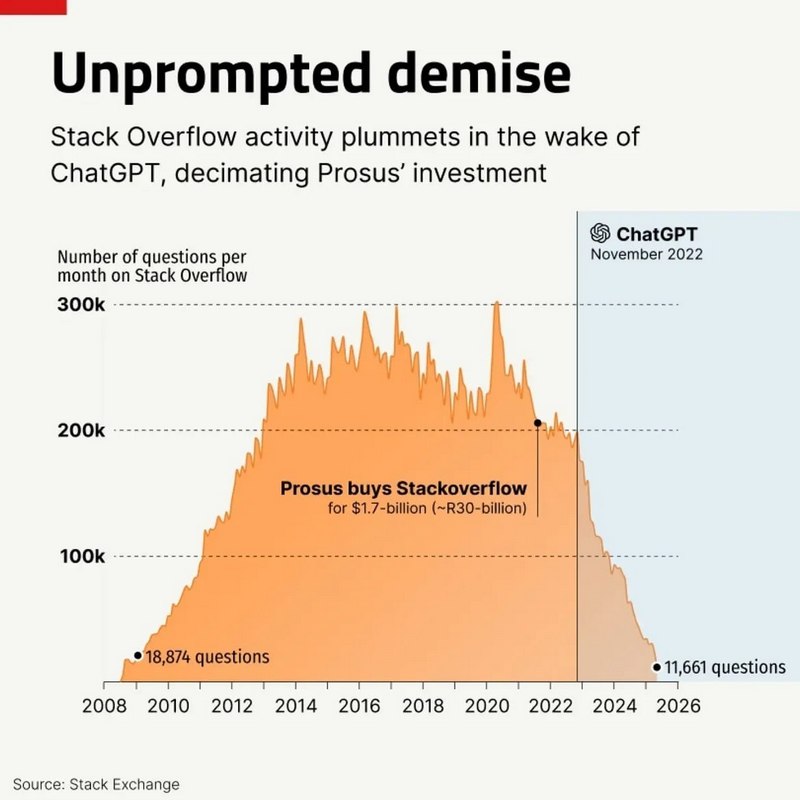
Stack Overflow was the undisputed holy grail of structured human logic. Back in 2019, I was building scraping bots for a sentiment model, and their API was the backbone of half the fintech startups in my portfolio. Right before ChatGPT dropped, Stack Overflow was pulling in 109,301 new questions a month.
Fast forward to July 2026.
1,624.
Read that again. A 98.5% collapse in organic query volume. Stack Overflow didn’t just lose traffic; it lost its fundamental reason to exist. Developers don’t search anymore. They prompt. When the well of human curiosity dries up, the ad-revenue and premium subscription models tied to it evaporate. Ghost towns don’t generate cash flow. And Quora is following right behind them, bleeding out 43% of its user interest as every stupid, brilliant, and mundane question simply moves into a private chat window.
The Great Margin Compression: Chegg and the Fiverr Powder Keg
Traffic is one thing. Willingness to pay is another. That’s where the real margin compression is happening.
Take Chegg. The moment their CEO finally admitted on an earnings call that LLMs were eating their lunch, the market punished them with a 48% single-day guillotine. Students aren’t dumb. Why pay $20 a month for a static answer key when the OS on your laptop gives you a better, customized tutor for free? You don’t. The subscription moat didn’t just leak; it was drained.
But Fiverr? That’s the one that actually keeps me up at night.
Fiverr held the line longer than most. For the first two years of the AI boom, they sat on a powder keg while models learned to code, translate, and design. Management kept pointing to “human touch” and “complex workflows.” Then, agentic AI got good. Models started chaining actions together—writing the brief, generating the logo, and formatting the delivery in four seconds for three cents of compute.
The keg blew.
The gig economy didn’t get disrupted. It got automated into obsolescence. When the cost of digital labor approaches zero, any platform taking a 20% cut of a $50 transaction is mathematically doomed.
The Visual Asset Trap: A Faustian Bargain
Here is where the capital allocation strategies of legacy media companies completely fell apart. Look at Shutterstock.
Once a $121 stock. Today? Hovering around $5.40. A 22x wipeout.
Shutterstock tried to play both sides. They licensed their massive image library to OpenAI while simultaneously rushing out their own proprietary generator. Classic corporate hedge. It failed miserably. You simply cannot sell your core asset to the very entity that is about to make it worthless. They sold the goose to buy a single, synthetic golden egg.
Getty Images took the opposite route. They chose litigation over innovation, suing Stability AI into the ground over Stable Diffusion. The result? They are down 98.6% since their SPAC merger days. Let me be blunt: suing your way to relevance is the ultimate bearish signal. The market doesn’t care about your copyright grievances if your core product is being generated in milliseconds on a GPU in a basement in Ohio.
The “Model Collapse” Risk (What Wall Street is Missing)
But here’s the wrinkle. The part nobody on the sell-side is pricing in yet.
This “Dead Internet” phenomenon isn’t just a tragedy for Web 2.0 stocks. It’s a massive, structural systemic risk for the AI hyperscalers themselves.
Think about it. If humans stop posting, stop asking, and stop uploading original thoughts… what the hell are GPT-5 and the next generation of Gemini training on?
Synthetic data.
I’ve been digging into the compute logs and research papers regarding “model collapse.” When you train an LLM on text generated by another LLM, the reasoning capabilities degrade. The model starts hallucinating harder, losing the nuanced edges of human chaos. The data moat that justified trillion-dollar valuations is evaporating because the raw material—human interaction—is being hoarded behind closed APIs or just ceasing to exist in the public web.
Wait, let me rephrase that. It’s not just evaporating. It’s being strip-mined, and the mine is almost empty.
How to Trade the Graveyard
So, how do you position a portfolio when the open web is dying?
- Stop catching falling knives. Legacy Q&A, stock photography, and basic gig-marketplaces are value traps. Their terminal growth rates are negative.
- Buy the closed-loop data. The winners of the next cycle aren’t scraping Reddit. They are buying proprietary, closed-loop datasets. Think specialized medical records, proprietary financial terminals (hello, Bloomberg), and private industrial telemetry.
- Long the picks and shovels of the new internet. If the public web is dead, where does the compute happen? Data centers, liquid cooling systems, and custom silicon. The physical infrastructure of AI is the only thing with a genuine moat left.
FAQ:
Is the “Dead Internet” theory actually impacting tech earnings?
Yes. The HarperFlow 2026 report confirms that legacy query-based and gig-based platforms are seeing 40% to 98% drops in organic engagement, directly hitting their top-line revenue and destroying their subscription retention metrics.
Why did Shutterstock stock crash so hard despite AI partnerships?
Shutterstock crashed from $121 to $5.40 because licensing their core IP to AI companies cannibalized their primary customer base. Investors realized that selling your foundational asset to your biggest existential threat is a terrible long-term capital allocation strategy.
What is the biggest risk to AI companies right now?
Data starvation and “model collapse.” As the public internet empties of original human input, AI companies are forced to train new models on synthetic, AI-generated data, which degrades reasoning capabilities and limits future scalability.
Why did Fiverr and Chegg lose their market value so quickly?
Both companies relied on the “knowledge and task arbitrage” model. Once agentic AI became capable of chaining complex tasks — coding, translating, designing — for fractions of a cent, the fundamental need to pay human freelancers or subscribe to static homework databases evaporated, leading to massive margin compression.
How should investors position their portfolios during this tech rotation?
Smart money is moving away from legacy Web 2.0 platforms — value traps with negative terminal growth — and rotating into companies that own closed-loop, proprietary datasets, as well as the physical infrastructure of AI: data centers, liquid cooling systems, and custom silicon manufacturers.
The old web is dead. Stop buying its corpses. If you want to survive the next market rotation, you need to look at who owns the proprietary data, not who used to host it.
Subscribe to our weekly Tech-Equity Alpha Newsletter for more unfiltered market analysis