Italy’s Guardia di Finanza has sent a Russian national to prosecutors over €11 million in alleged evaded taxes, after investigators concluded she lived in Alassio from 2018 while staying paper-resident in Russia, hiding €7 million of income and a €50 million investment portfolio at home www.ilsecoloxix.it. And here’s the twist nobody priced: with the Italy-Russia tax treaty partially suspended, there is no relief left to soften the bill www.facebook.com.
IMPORTANT RISK WARNING: The information provided in this article is for educational and informational purposes only. It does not constitute financial advice, investment advice, or trading advice. Trading and investing involve substantial risk of loss, including the potential loss of principal. Past performance is not indicative of future results. Always conduct your own research (DYOR) and consult a licensed financial advisor before making any investment decisions.
Note: the case is at prosecution stage. Everything below describes allegations, not a verdict.
The case that started with a penthouse
Audits rarely begin with a spreadsheet. This one began with bricks. The Finance Guard of Savona province started checking the woman after a string of luxury purchases: six apartments in Liguria worth about €5 million and a penthouse above €2 million www.ilsecoloxix.it. Property registers are public. Lifestyle is loud.
What investigators then assembled looks like a textbook factual-residency file: habitual abode in Alassio since 2018, €7 million of undeclared income, a Russian investment portfolio around €50 million, and roughly €4 million of unpaid tax on foreign assets under Italy’s monitoring rules www.mattinopadova.it. The file now sits with the Savona prosecutor for recovery www.grnet.it.
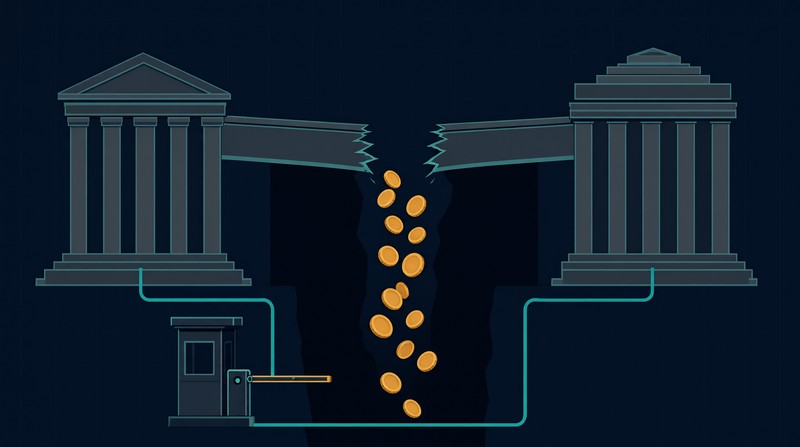
Now the macro layer, because this is where the story stops being local. Italy and Russia used to run a double taxation treaty like plumbing: you pay once, you credit once, you move on. That plumbing is cut. Under Legislative Decree 192/2025, Italy mirrors foreign suspensions, and on 13 March 2026 it formally notified Russia that Articles 5 to 23 and Article 25 are suspended www.facebook.com. No treaty credits. No relief. Double taxation stops being a risk and becomes the default setting.
Two consequences follow, and both are bigger than one penthouse. First, with information exchange dead, enforcement migrates to what auditors can see: deeds, marina berths, school enrollments, utility contracts. Second, every cross-border household between the two countries now prices the same exposure. The Guardia di Finanza seized over €6 billion in a recent annual cycle www.facebook.com; the appetite is there, and the Riviera file is the template.
My playbook: how residency gets proven, and how treaties die
I keep a one-page residency test on my desk because I got burned once and refuse to get burned twice. Registration is evidence. Facts are the rule. If your life runs on Italian time – 183-plus days, family enrolled locally, doctor, gym, the boring stuff – you are Italian-resident for tax purposes, whatever your passport folder says.
A personal case, with the numbers. In February 2025 a contractor friend billed through an Estonian company and wintered in Liguria, convinced his e-residency card settled the question. It settled nothing. We counted 196 days in Italy, a spouse registered at a Genoa school, and a utility trail straight to Alassio-adjacent coast. We re-registered him in Italy before summer. His IVIE on a €380,000 flat works out to about €2,900 a year at the 0.76% rate, plus IVAFE on the brokerage. The alternative? An audit reconstructing the same facts from 2018-style records, with penalties starting where the tax stops. Cheap insurance beats expensive arithmetic.
| Parameter | Treaty in force | Treaty suspended (post-March 2026) |
| Foreign tax credit | Available | Gone for suspended articles |
| Double taxation risk | Managed | Structural |
| Foreign asset monitoring (RW, IVIE/IVAFE) | Still mandatory | Mandatory, and now unrelieved |
| Audit trigger | Data exchange | Lifestyle and property records |
| Dispute channel | Mutual agreement | Mostly closed |
Five steps I run on any cross-border setup now, in this order: map the facts (days, family, economic centre); inventory every foreign asset and its reporting line; model the tax twice – with and without treaty; fix registration before an auditor fixes it for you; keep an evidence folder, dated, because memory loses to paperwork. If your yield hunting already runs through foreign accounts, the same discipline applies: read the reporting rules before the returns, not after (we mapped the yield-migration trend in Investors Searching for US Dollar Yield in 2026 Are Looking Beyond Banks, and the compliance tail on that trade keeps growing).
The uncomfortable part: enforcement hits the visible first
Let’s say the quiet thing out loud. The Alassio file exists because someone bought six apartments in a register that publishes deeds. Renters, trust holders, and people who never touch a notary slide past the same net. Enforcement asymmetry is not a bug here; it is the whole mechanism, and it rewards opacity.
Then the collateral damage. Treaty suspension does not check your net worth before it bites. Pensioners splitting years between two countries, students, mid-career contractors – all now face unrelieved double taxation on ordinary income, because mirror suspensions are blunt by design
. A policy built to squeeze oligarch-adjacent wealth lands on anyone whose life crosses the border.
And the market-level effect: capital that cannot price its tax risk does not go home. It goes dark. Opaque structures, nominee holdings, crypto rails with worse reporting – the same migration we tracked in cross-border flows when foreign holders repriced US Treasuries. States win individual cases and lose visibility. That trade-off deserves more airtime than it gets.
One more flag for fairness: the Savona file is an allegation set forwarded to prosecutors. Presumption of innocence applies. The signal for planners is the mechanism, not the person.
FAQ
What did Italy’s Finance Guard allege in the Alassio case?
Investigators allege a foreign national habitually living in Alassio since 2018 hid €7 million of income, held a €50 million investment portfolio in Russia without declaration, and owed about €4 million more on foreign-asset taxes, totalling €11 million. The file went to the Savona prosecutor for recovery.
Is the Italy-Russia double taxation treaty still in force?
Only in fragments. Italy notified Russia on 13 March 2026 that Articles 5 to 23 and Article 25 are suspended, mirroring Russia’s own move under Legislative Decree 192/2025. Credits and relief under those articles no longer apply, so double taxation becomes the default for cross-border income.
What are IVIE and IVAFE, and who pays them?
IVIE is Italy’s annual tax on foreign real estate held by Italian tax residents, roughly 0.76% of property value; IVAFE taxes foreign financial assets, generally 0.2%. Both ride on the quadro RW monitoring declaration. Residents cannot skip them by keeping assets abroad; the Alassio file shows auditors reconstruct holdings from lifestyle evidence.
Can Italy claim tax residency if I am registered elsewhere?
Yes. Registration is evidence, not verdict. Habitual abode over 183 days, centre of vital interests, family location and economic ties decide factual residency. Courts and auditors weigh utility contracts, school enrollment and medical registration heavily, which is exactly how the Alassio file was built.
What happens to my taxes when a treaty is suspended?
Domestic law applies alone. Foreign tax credits disappear for suspended articles, mutual agreement procedures mostly close, and the same income can be taxed twice. Planning shifts from treaty optimization to residency facts, timing of income, and asset location, the boring triad that survives every decree.
Final thoughts
Treaties were the plumbing of globalized wealth: invisible, reliable, taken for granted. 2026 is unplumbing it one mirror decree at a time, and the Alassio file shows what fills the vacuum – auditors reading marina lists and deed registers like trading desks read order flow. Old money adapts, mid money gets caught, and everyone in between should re-run their residency math this quarter, not after a letter arrives. Nothing here is advice; the disclaimer above stands, and the presumption of innocence stands with it.